
The Body as a Microsystem: How Acupuncture Maps Healing Across the Whole Self
The Body Is a Map of Itself
One of the most fascinating aspects of Traditional Chinese Medicine (TCM) is the idea that the body contains multiple maps of itself — each part reflecting the whole. These microsystems allow practitioners to access and influence the body’s balance through specific, smaller regions such as the ear, tongue, scalp, hands, or feet.
It’s a concept both ancient and elegantly simple: harmony in one part reflects harmony in the whole.
Ancient Foundations in TCM
For thousands of years, Traditional Chinese Medicine has understood that the human body operates as a unified energy network. Rather than treating symptoms in isolation, acupuncture and herbal medicine aim to restore balance through Qi, the body’s vital energy, which flows through meridians connecting organs, tissues, and emotions.
Within this framework, certain areas of the body — like the tongue, face, or ear — are seen as mirrors of internal health. Observation of these areas, and stimulation through acupuncture or acupressure, can influence the entire system.
The Ear: A Microsystem of the Whole Body
The ear is one of the most well-researched microsystems in acupuncture.
In the 1950s, Dr. Paul Nogier, a French neurologist, observed that the ear reflected the human body in miniature — like an inverted fetus. He mapped how different points correspond to specific organs and functions. His work became the foundation of auriculotherapy, now widely used worldwide.
Building on this, researchers such as Dr. Terry Oleson helped bring scientific credibility to auricular acupuncture through modern studies and clinical trials, showing how stimulating points on the ear can impact the nervous system, reduce pain, and improve emotional balance.
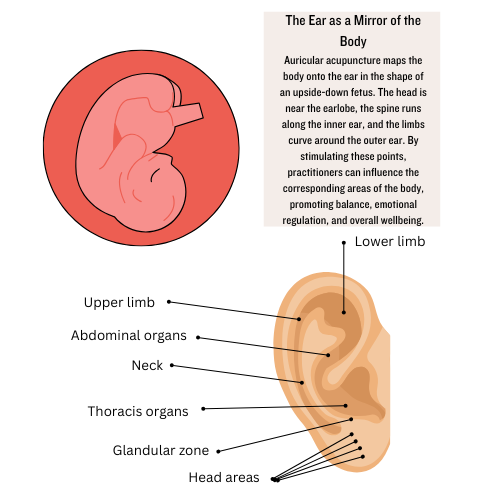
The Ear as microsystem of the whole body
One of the most recognised applications today is the NADA Protocol (National Acupuncture Detoxification Association) — a five-point ear acupuncture treatment that promotes calm, supports recovery from addiction, and helps regulate stress and trauma responses.
Five NADA points:
Shen Men (Spirit Gate) — calms the mind
Sympathetic — balances the autonomic nervous system
Kidney — supports willpower and vitality
Liver — aids detoxification and emotional flow
Lung — releases grief and promotes respiration
The NADA Protocol is now used globally in community, clinical, and trauma recovery settings.
The Tongue: A Window Into Inner Health
In Traditional Chinese Medicine, the tongue is one of the most important diagnostic tools — a microsystem that reveals the state of the body’s internal organs and energy.
Each region of the tongue corresponds to a different organ:
Tip: Heart and Lung
Center: Stomach and Spleen
Sides: Liver and Gallbladder
Root: Kidneys and Bladder
Practitioners look at the color, coating, shape, and moisture of the tongue to understand imbalances. For example, a red tip may suggest emotional or heart-related heat (often linked to stress or anxiety), while a pale, swollen tongue might point to fatigue or digestive weakness.
The Scalp: Accessing the Brain’s Energy Pathways
Scalp acupuncture is a relatively modern development in TCM, blending traditional theory with modern neurology. Specific zones of the scalp correspond to areas of the brain, allowing stimulation of motor, sensory, and emotional functions.
It’s often used to support recovery after stroke, neurological disorders, or chronic pain conditions. The results can be profound — small points on the scalp can trigger systemic change and restoration of movement or sensation.
Hands, Feet, and Face: Everyday Pathways to Balance
Like the ears, the hands and feet also contain complete maps of the body. These microsystems are the basis for therapies such as reflexology and hand acupuncture.
Hand acupuncture can be used for tension, headaches, and emotional stress.
Foot points connect to grounding and vital organs, supporting sleep, circulation, and calm.
Facial acupuncture mirrors the body’s internal health and is often used for both cosmetic and emotional wellbeing — improving circulation, easing jaw tension, and enhancing radiance.
The Whole Within the Part
The beauty of acupuncture and TCM lies in this principle: every part of you is connected. Whether through an ear point calming the heart, or a gentle needle on the scalp helping restore movement, these microsystems remind us that healing doesn’t always need to be complex — it just needs to listen to the body’s own intelligence.
When we work with the body as a microsystem, we’re not just treating parts — we’re speaking directly to the whole.
Final Thought
From ancient meridian maps to modern neuroscience, the body continues to prove that it is both profound and precise. Microsystem acupuncture — from the ear to the tongue — shows us that healing can begin anywhere, and that balance is always within reach.